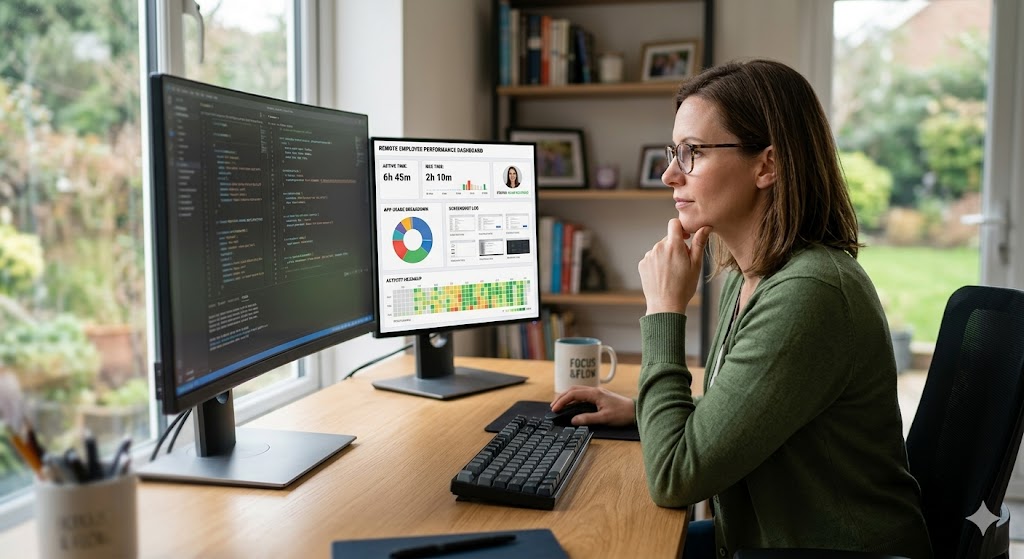
Struggling to manage remote teams? Learn how to maintain accountability in a remote work environment using proven systems, tools, and monitoring strategies.
Remote work has fundamentally changed how businesses operate. What started as a temporary adjustment has now become a long term strategy for companies looking to reduce costs, access global talent, and improve flexibility.
But with all its advantages, remote work introduces one persistent challenge: accountability.
In a traditional office, accountability often comes naturally. Managers can see who is working, conversations happen organically, and progress is visible. In a remote environment, all of that disappears. What replaces it is not visibility but uncertainty.
Many business leaders begin to ask:
- Are my employees actually working?
- Why are deadlines slipping?
- Why is productivity inconsistent?
The answer is rarely laziness. More often, it is the absence of clear systems for accountability.
The Shift from Presence to Performance
One of the biggest adjustments companies must make is moving away from managing people based on presence. In an office, someone sitting at their desk gives the illusion of productivity. In remote work, that illusion disappears.
What replaces it is something more meaningful: performance based accountability.
This means measuring:
- What is delivered
- How consistently it is delivered
- The quality of the output
When companies fail to make this shift, they either become overly controlling or completely hands off. Both extremes create problems. Too much control leads to micromanagement and low morale. Too little structure leads to confusion and missed expectations.
A well functioning remote team sits in the middle structured, visible, and outcome driven.
According to Harvard Business Review, organizations that focus on outcomes rather than activity tend to see higher engagement and better long term performance.
Why Accountability Breaks Down Remotely
Accountability doesn’t disappear in remote teams it simply becomes harder to enforce without deliberate systems.
In many cases, businesses unintentionally create environments where accountability cannot thrive. Expectations are vague, roles are loosely defined, and communication is inconsistent. Employees are left guessing what matters most, and managers are left wondering why things are not getting done. The result is a cycle of frustration on both sides.
Leaders often assume the issue is discipline. In reality, it is usually a lack of clarity and structure.
When employees don’t clearly understand what success looks like, they cannot consistently deliver it. When managers cannot see progress, they begin to lose confidence in their teams.
Breaking this cycle requires more than motivation, it requires designing accountability into the system.
Visibility: The Foundation of Remote Accountability
In a remote environment, visibility replaces physical presence.
This does not mean surveillance. It means having clear insight into:
- What tasks are being worked on
- How long tasks are taking
- Whether deadlines are being met
Without visibility, managers are forced to rely on assumptions. And assumptions are rarely accurate.
This is where remote work monitoring becomes essential. Tools like Time Doctor provide a structured way to understand how work is being done without disrupting employees.
At Delon Apps, we provide similar monitoring solutions designed specifically for businesses managing distributed teams:
The goal of monitoring is not to control people it is to create transparency. When transparency exists, accountability becomes easier for both managers and employees.
Creating Clarity in Roles and Expectations
One of the most overlooked aspects of accountability is role definition.
In many remote teams, responsibilities overlap or remain unclear. Employees may not know where their duties begin and end, and managers may assume expectations are understood when they are not.
This creates gaps, gaps where tasks fall through, deadlines are missed, and accountability weakens.
Clarity solves this.
When each role is clearly defined, and each task has a clear owner, there is no ambiguity. People know what they are responsible for, and managers know who to hold accountable.
This clarity should extend beyond job descriptions. It should include:
- Specific deliverables
- Measurable outcomes
- Expected timelines
Once expectations are defined this way, accountability becomes a natural extension of the system.
The Role of Structured Communication
In an office, communication happens naturally. In remote teams, it must be intentional.
Without structure, communication becomes reactive instead of proactive. Messages are missed, updates are delayed, and misunderstandings increase.
Structured communication solves this problem by creating rhythm.
Daily updates, weekly reviews, and regular check ins create a consistent flow of information. They ensure that progress is visible and issues are identified early.
Tools like Slack play a critical role in maintaining this flow.
But tools alone are not enough. What matters is how they are used.
When communication becomes consistent, accountability improves because everyone stays aligned. When communication is inconsistent, accountability breaks down because no one has a clear picture of what is happening.
Turning Tasks into Measurable Outcomes
One of the biggest challenges in remote work is the lack of measurable performance.
When work is not tied to clear metrics, accountability becomes subjective. Managers rely on perception instead of data, and employees may feel unfairly evaluated.
The solution is to define Key Performance Indicators (KPIs) for each role.
These KPIs should reflect real output:
- Tasks completed
- Response times
- Sales generated
- Customer satisfaction levels
Tracking these metrics using tools like Google Sheets allows managers to evaluate performance objectively.
When performance is measurable, accountability becomes fair and transparent.
Building a Culture That Supports Accountability
Systems and tools are important, but they are not enough on their own.
Accountability also depends on culture.
In strong remote teams, accountability is not enforced it is expected. Employees take ownership of their work, communicate proactively, and follow through on commitments.
This culture is built over time through:
- Clear expectations
- Consistent feedback
- Recognition of good performance
When employees feel trusted and supported, they are more likely to take responsibility. When they feel micromanaged or ignored, accountability weakens.
Deepening Accountability: Turning Remote Work into a High Performance System
Once the foundations of accountability clarity, visibility, and structured communication are in place, the next level is about refinement and consistency. This is where many remote teams either plateau or begin to outperform traditional office based teams.
The difference lies in how intentionally accountability is reinforced over time.
Making Accountability Part of Daily Operations
In high performing remote teams, accountability is not something that is checked occasionally. It is embedded into daily operations.
Work does not move forward randomly, it follows a predictable flow. Tasks are assigned, tracked, reviewed, and completed within a visible system. Everyone knows what is expected, and more importantly, everyone knows that their work is being seen.
This daily rhythm removes the need for constant supervision. Instead of managers chasing updates, updates are naturally available through systems and tools.
Over time, this creates a shift:
- From reactive management → to proactive oversight
- From uncertainty → to clarity
- From delays → to consistency
The Power of Real Time Visibility
One of the most powerful aspects of remote work, when done right, is the ability to track work in real time.
Unlike traditional offices where visibility is often based on physical presence, remote environments can provide data driven visibility. This includes:
- Time spent on tasks
- Applications used during work hours
- Task completion rates
- Productivity trends over time
This level of insight allows managers to identify patterns that would otherwise go unnoticed.
For example, if a team member consistently takes longer on certain tasks, it may indicate:
- A skill gap
- A process inefficiency
- A need for better tools
Monitoring platforms like Time Doctor provide this level of insight without disrupting workflows.
Delon Apps’ remote monitoring systems are structured to give businesses clarity without creating unnecessary pressure.
The goal is not to monitor every second, it is to understand how work is happening and improve it.
Reducing Dependence on Constant Supervision
One of the biggest misconceptions about accountability is that it requires constant supervision.
In reality, strong accountability systems reduce the need for supervision.
When:
- Tasks are clearly defined
- Deadlines are visible
- Progress is tracked
…employees can manage their own work with minimal intervention.
This creates a more efficient environment where managers focus on:
- Strategy
- Problem solving
- Growth
Instead of:
- Following up constantly
- Asking for updates
- Checking if work is being done
Over time, this shift improves both productivity and morale.
Encouraging Proactive Communication
In remote teams, silence is often mistaken for progress. Just because no one is complaining does not mean everything is working.
Accountability improves when communication becomes proactive rather than reactive.
This means employees:
- Share updates before being asked
- Report issues early
- Ask for clarification when needed
Managers, in turn, create an environment where communication is expected and supported.
Platforms like Slack or Microsoft Teams help facilitate this flow.
But the real driver is not the tool, it is the expectation.
When proactive communication becomes the norm, accountability strengthens naturally because nothing stays hidden for long.
Using Data to Drive Performance Conversations
One of the advantages of remote work monitoring is the ability to replace subjective opinions with objective data.
Instead of saying:
- “You don’t seem productive”
You can say:
- “Your task completion rate has dropped by 20% this week”
This shifts conversations from personal judgment to performance improvement.
Data driven discussions are:
- More constructive
- Less emotional
- Easier to act on
They also create fairness across the team, as everyone is evaluated using the same metrics.
Strengthening Accountability Through Feedback Loops
Accountability is not just about tracking performance it is also about improving it.
This is where feedback becomes essential.
Regular feedback loops ensure that:
- Employees know where they stand
- Improvements are made quickly
- Performance stays aligned with expectations
Feedback should not be reserved for formal reviews. It should be continuous and integrated into daily operations.
When feedback is consistent:
- Small issues are corrected early
- Performance improves steadily
- Employees feel supported rather than criticized
Preventing Burnout While Maintaining Accountability
A common concern with remote monitoring is that it may lead to pressure or burnout.
This usually happens when accountability systems are poorly implemented.
True accountability is not about maximizing output at all costs. It is about sustainable performance.
This means:
- Setting realistic expectations
- Allowing flexibility where needed
- Recognizing effort and results
When employees feel that accountability is fair and balanced, they are more likely to stay engaged and productive.
Scaling Accountability as Your Team Grows
What works for a small team may not work for a larger one.
As your remote team grows, accountability systems must evolve.
This includes:
- More structured reporting
- Clearer hierarchy of responsibilities
- Better defined workflows
At scale, informal systems break down. Processes must be documented, and tools must be used consistently.
Platforms like Asana or ClickUp become essential for maintaining structure.
Without this evolution, growth leads to chaos instead of progress.
Aligning Individual Work with Business Goals
Accountability improves significantly when employees understand how their work contributes to the bigger picture.
When tasks feel disconnected from outcomes, motivation drops. When tasks are clearly linked to business goals, engagement increases.
Managers should regularly connect:
- Individual responsibilities
- Team objectives
- Company goals
This alignment creates a sense of purpose, which strengthens accountability at every level.
Turning Accountability into a Competitive Advantage
Many companies view accountability as a challenge in remote work. The most successful ones turn it into an advantage.
With the right systems, remote teams can:
- Operate more efficiently than office teams
- Deliver work faster
- Maintain higher levels of transparency
This is because remote accountability systems are often more structured and data driven.
Companies that invest in these systems position themselves to:
- Scale faster
- Reduce inefficiencies
- Improve overall performance
The Long Term Impact of Strong Accountability Systems
When accountability is properly implemented, the benefits extend beyond daily operations.
Over time, businesses experience:
- More predictable performance
- Stronger team reliability
- Improved decision making
- Faster execution of strategies
What starts as a solution to a remote work challenge becomes a core strength of the organization.
Addressing Problems Before They Escalate
In remote teams, small issues can quickly become large problems if they are not addressed early.
A missed deadline may seem minor, but repeated delays signal deeper issues. Poor communication from one team member can disrupt the entire workflow.
The key is to act early.
When performance drops or expectations are not met, it is important to:
- Identify the issue
- Communicate clearly
- Reset expectations
- Monitor improvement
Ignoring problems does not make them go away, it makes them harder to fix later.
The Balance Between Trust and Control
One of the most delicate aspects of remote work is finding the right balance between trust and control.
Too much control creates stress and reduces motivation. Too little structure creates confusion and inconsistency.
The most effective approach is structured trust.
This means:
- Trusting employees to do their work
- Providing systems that make work visible
- Using data to guide decisions
When this balance is achieved, accountability becomes part of the system rather than something that needs constant enforcement.
Conclusion
Maintaining accountability in a remote work environment is not about finding better employees, it is about building better systems.
When roles are clear, communication is structured, performance is measurable, and work is visible, accountability becomes natural.
Without these elements, even the best employees will struggle.
If your remote team lacks visibility, consistency, or performance tracking, now is the time to fix it. Don’t wait until inefficiencies start affecting your revenue and growth.
Delon Apps can help you implement effective remote work monitoring and accountability systems.
Suggested Reads
 Teniola Makinde
Building a Lean Business Model with Virtual Assistant Support
 Teniola Makinde
Using Resolution Consulting to Rebuild Customer Trust
 Teniola Makinde
The Role of Software Development in Business Growth and Digital Transformation
 Teniola Makinde
Common Myths About Staff Outsourcing That Businesses Should Stop Believing
 Teniola Makinde
How Automated Timesheets Simplify Remote Employee Payroll
 Teniola Makinde
How Virtual Assistants Help Improve Customer Retention
.jpg) Teniola Makinde
Teniola Makinde
How Resolution Consulting Can Improve Employee Relations
 Teniola Makinde
Why Businesses Should Modernize Their Legacy Software Systems
 Teniola Makinde
How Delon Apps Helps Businesses Resolve Complex Organizational Challenges
 Teniola Makinde